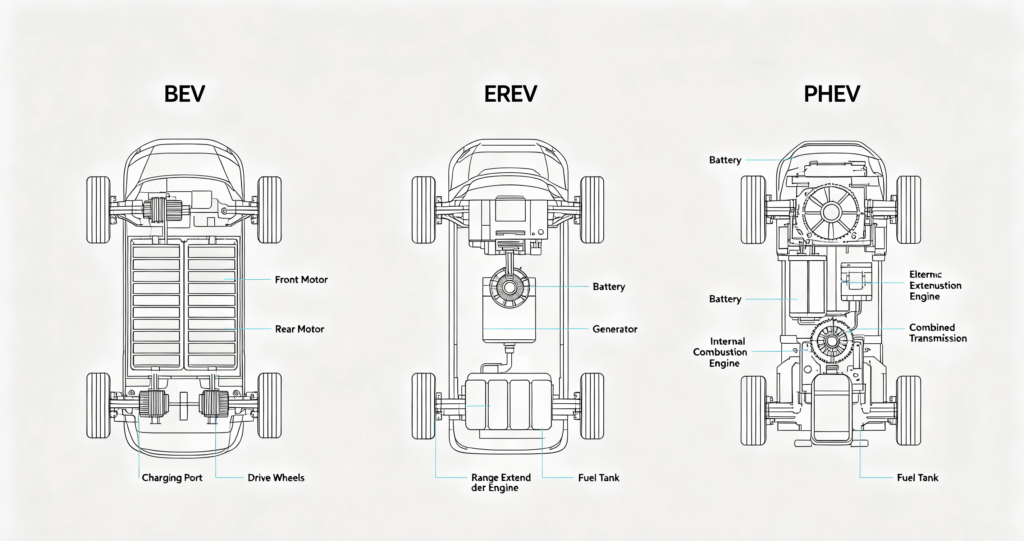
When choosing new energy vehicles, most global buyers are confused by three mainstream types: Battery Electric Vehicles (BEV), Extended-Range Electric Vehicles (EREV), and Plug-in Hybrid Electric Vehicles (PHEV). These three core new energy models differ greatly in power structure, driving logic, daily usage and applicable scenarios. Understanding their essential differences helps users select the most suitable vehicle for personal travel habits and road conditions.
1. BEV (Battery Electric Vehicle): Pure Electric Vehicle
BEV is the most straightforward new energy vehicle with the simplest structure. It is fully equipped with batteries, motors and electronic control systems, without any fuel engine or fuel tank. The vehicle is 100% driven by electric power, relying entirely on external charging for energy supplementation.
Pure electric vehicles deliver the smoothest and quietest driving experience. The motor outputs power instantly without shift shock or engine noise, bringing superior comfort for urban commuting. With no mechanical engine maintenance parts, daily maintenance is simpler and more cost-effective. In addition, BEVs achieve zero tailpipe emissions during operation, fully complying with global low-carbon travel standards.
The only limitation is range anxiety. BEVs rely completely on charging piles. Long-distance travel requires reasonable charging planning, making them more suitable for users with fixed parking spaces and home charging piles, who mainly drive in cities and pursue low daily travel costs.
2. EREV (Extended-Range Electric Vehicle): Range-Extension EV
The EREV is essentially an electric vehicle with a “portable power generator”. It retains the pure electric driving experience of BEVs and adds a small-displacement fuel range extender. The core rule determines its uniqueness: the engine never drives the wheels directly. It only generates electricity to charge the battery or supply power to the motor when the battery is low.
Under daily full-power conditions, EREVs run purely on electricity, exactly the same as pure electric vehicles in terms of quietness and smoothness. When the battery power is exhausted, the range extender automatically starts to generate power. Users can refuel directly for continuous driving, completely eliminating range anxiety. It perfectly combines low-cost pure electric daily commuting and unrestricted long-distance travel.
EREVs are ideal for users who love the pure electric driving feel but frequently take long-distance self-driving trips or lack stable charging conditions. It is a versatile model with zero travel restrictions.
3. PHEV (Plug-in Hybrid Electric Vehicle): Plug-in Hybrid EV
PHEV is a dual-power integrated vehicle equipped with a complete engine, motor and battery system. It has two independent driving modes and is the most flexible new energy model. Different from EREV, the PHEV engine can directly drive the wheels and cooperate with the motor to output power simultaneously.
With sufficient power, PHEVs work as pure electric vehicles for zero-cost urban commuting. When power is insufficient or strong power is needed for overtaking and climbing, the engine and motor work together to provide stronger comprehensive power and better high-speed stability. It supports both external charging and fuel refueling, adapting to all road conditions and travel scenarios.
Thanks to the dual-power synergy, PHEVs have excellent high-speed performance and extreme adaptability. They are suitable for users with mixed urban and high-speed travel scenarios, pursuing both fuel economy and power performance.
Core Summary & User Selection Guide
BEV: Zero fuel consumption, ultra-smooth ride, low maintenance cost. Best for city daily commutes and users with stable charging conditions.
EREV: Pure electric driving experience + unlimited range. Best for users pursuing comfort and needing both urban commute and long-distance travel.
PHEV: Dual oil-electric power, strong comprehensive performance, full-scenario adaptation. Best for mixed road conditions and users pursuing balanced power and economy.