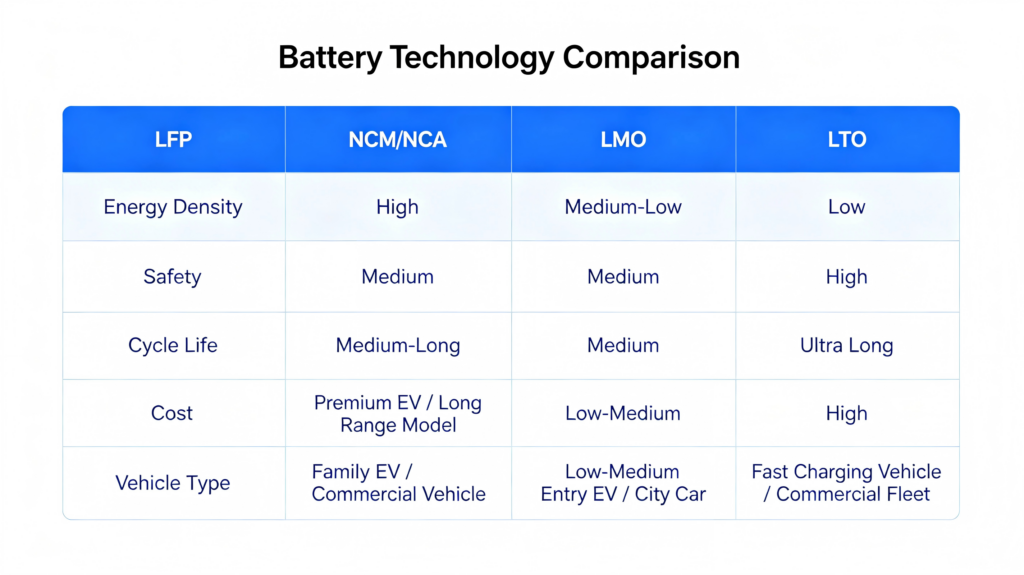
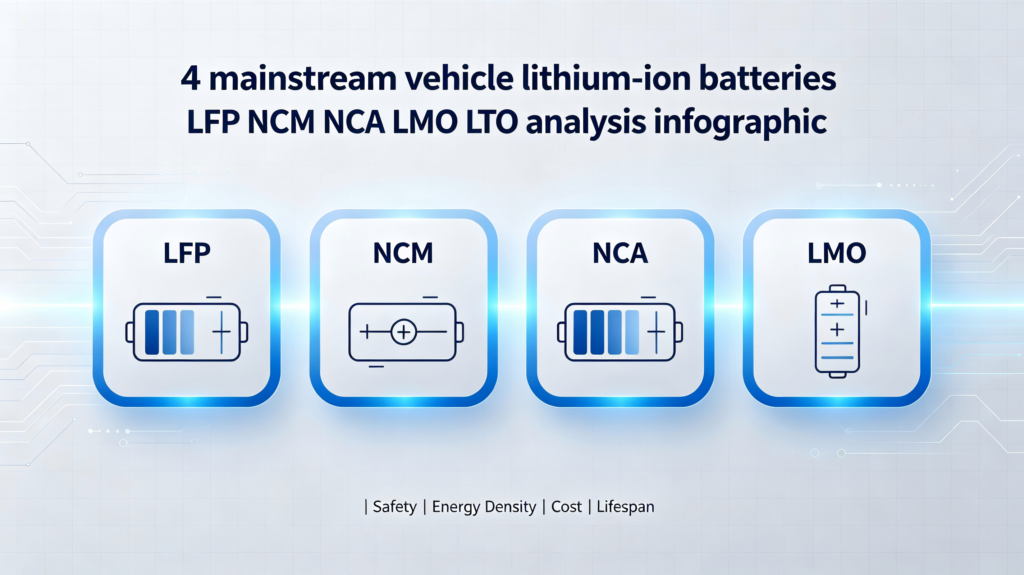
Lithium-ion batteries are the core energy carrier of new energy vehicles. At present, four types of lithium batteries are widely used in the global automotive industry: Lithium Iron Phosphate (LFP), Ternary Lithium (NCM/NCA), Lithium Manganese Oxide (LMO), and Lithium Titanate (LTO). Each battery type has unique advantages in energy density, safety, service life, cost and low-temperature performance. This article analyzes the characteristics, applicable scenarios and pros and cons of the four mainstream vehicle batteries in detail.
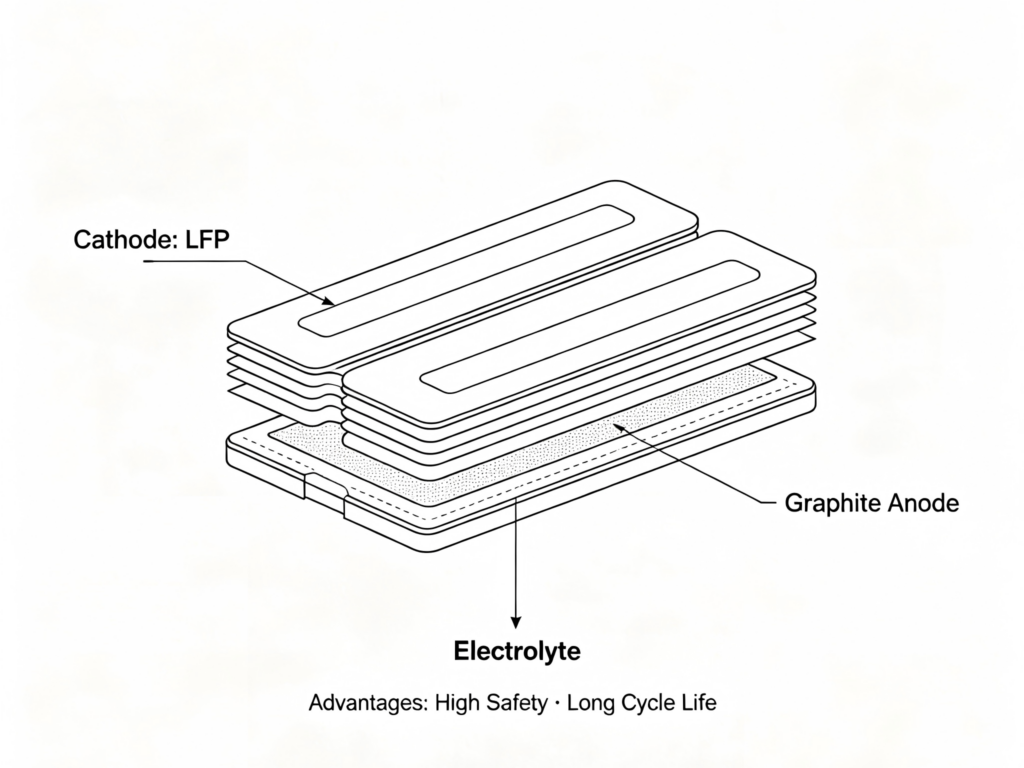
1. LFP (Lithium Iron Phosphate Battery)
LFP is currently the most widely used power battery for mass-market new energy vehicles. Its cathode material is iron phosphate without precious metal elements such as cobalt and nickel. This structure greatly reduces production costs and improves industrial popularity.
The biggest advantage of LFP batteries is ultra-high safety and long cycle life. The material structure is extremely stable and will not decompose or release oxygen under high temperature or severe collision. It effectively avoids thermal runaway and spontaneous combustion risks. Its charging and discharging cycle life can reach more than 3,000 times, far exceeding ordinary ternary batteries.
In terms of weaknesses, LFP has low energy density and poor low-temperature performance. In extremely cold environments, the battery capacity decays obviously. It is more suitable for mainstream family electric vehicles, commercial vehicles and fleet models that pursue cost stability and high safety.
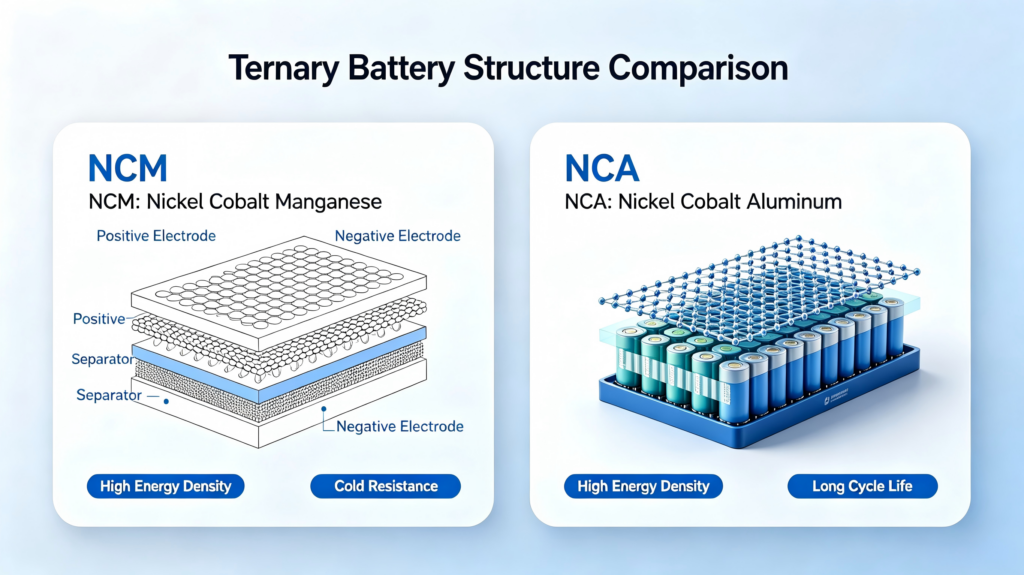
2. NCM / NCA (Ternary Lithium Battery)
Ternary lithium batteries include NCM (Nickel-Cobalt-Manganese) and NCA (Nickel-Cobalt-Aluminum). They adopt ternary composite cathode materials and are currently the mainstream batteries for high-end and long-range new energy vehicles.
The core advantage of ternary batteries is high energy density and excellent low-temperature performance. They can store more electricity in the same battery volume, effectively supporting ultra-long cruising ranges. In cold weather, their capacity attenuation is much lower than that of LFP batteries, making them more adaptable to high-latitude regions.
However, ternary batteries contain precious metals such as cobalt and nickel, leading to higher manufacturing costs. Their material stability is weaker than LFP. Under extreme high temperature or strong impact, thermal runaway risk exists. The cycle life is about 1,500 to 2,000 times, which is suitable for luxury electric vehicles, high-performance cars and models pursuing extreme endurance.
3. LMO (Lithium Manganese Oxide Battery)
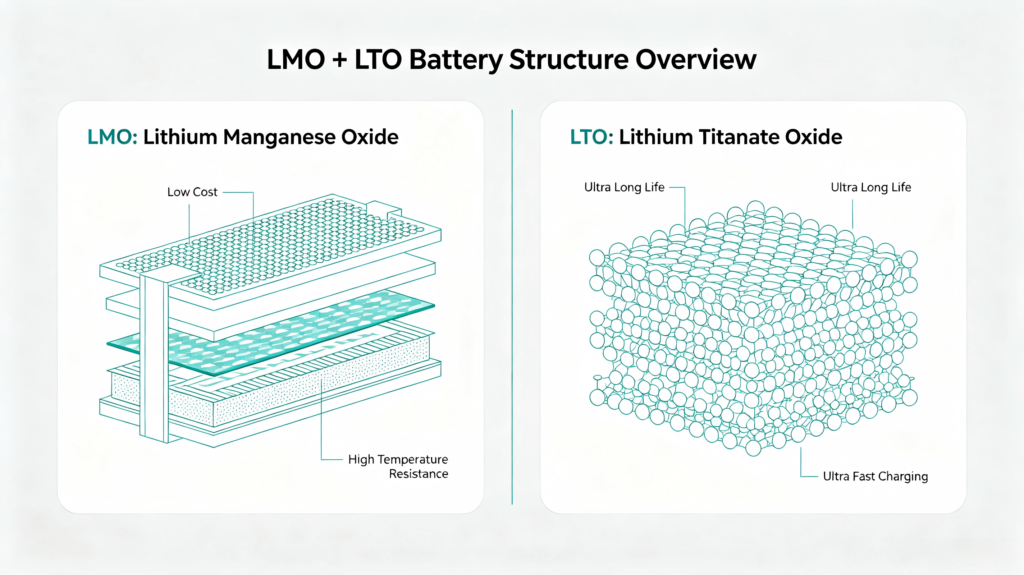
LMO lithium manganese oxide battery is a cost-effective and safe lithium battery. It features low material cost, good thermal stability and excellent overcharge resistance.
LMO batteries have strong safety performance and good high-temperature resistance. They are not easy to bulge or burn under abnormal working conditions. Their low-cost raw materials make them very suitable for medium and low-speed new energy vehicles, electric commercial vehicles and engineering vehicles.
The main shortcomings of LMO are low energy density and poor cycle stability. Manganese dissolution occurs during long-term charging and discharging, resulting in gradual battery attenuation. It is mostly used in cost-sensitive scenarios that do not require ultra-long battery life.
4. LTO (Lithium Titanate Battery)
LTO lithium titanate battery is known as the “ultra-long life safety battery” in the industry. It uses lithium titanate as the negative electrode material, replacing the traditional graphite negative electrode.
LTO’s biggest highlights are ultra-long cycle life, extreme safety and super fast charging capability. Its cycle life can exceed 20,000 times, which is far beyond other lithium batteries. It supports ultra-high current fast charging and has almost no thermal runaway risk. It also maintains stable performance in extremely low and high temperature environments.
Due to high production costs and low energy density, LTO is not suitable for ordinary passenger cars. It is mainly applied in high-frequency operation scenarios such as urban buses, logistics vehicles, special engineering vehicles and vehicle energy storage systems.
Core Comparison & Vehicle Selection Summary
LFP: Balanced safety and cost, long service life, mainstream choice for family passenger cars and commercial vehicles.
NCM/NCA: High energy density, strong low-temperature performance, preferred for high-end vehicles and long-range models.
LMO: High cost performance and high safety, suitable for medium-low speed vehicles and engineering equipment.
LTO: Ultra-long life and super safety, dedicated to high-frequency commercial operation vehicles.