
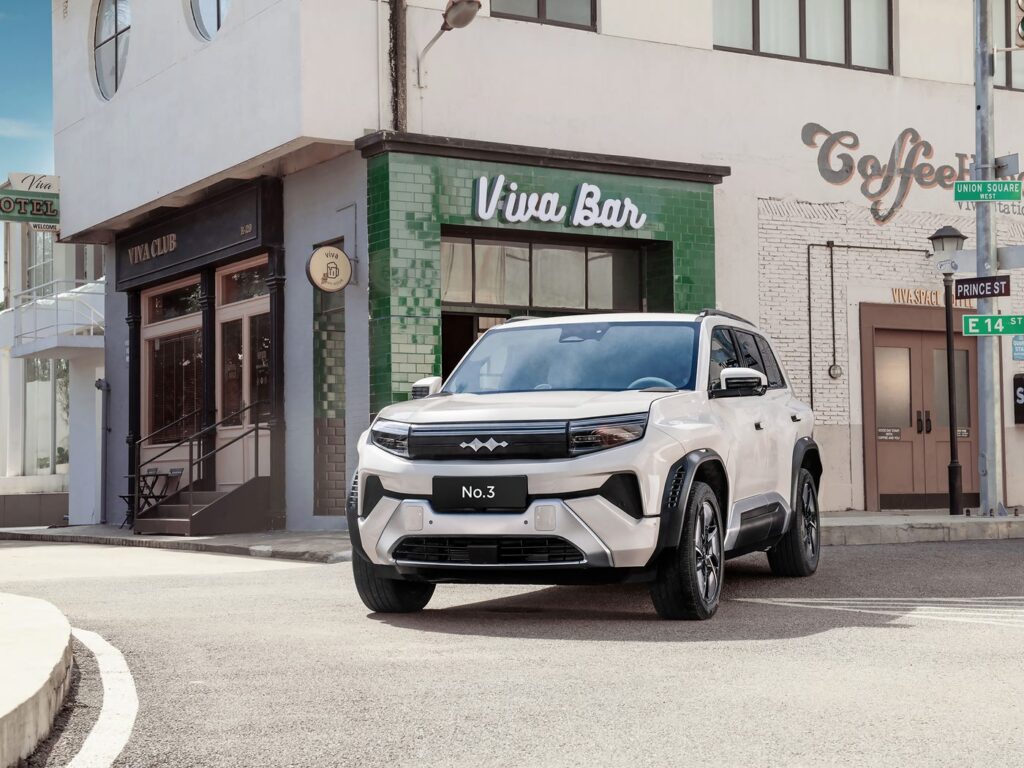
In the Middle East, boxy cars have never lacked a market—the Toyota Land Cruiser, Jeep Wrangler, and Mercedes-Benz G-Class have long proven this. But this time, a boxy battery-electric SUV from China is winning over buyers who previously only considered fuel-powered off-roaders. It’s the Fangchengbao Titanium 3.
In early 2026, if you walk the streets of Dubai or Riyadh, you’ll notice a new sight: a sharp, square electric SUV quietly weaving through the sea of Land Cruisers and Wranglers. Its badge reads Fangchengbao, and the model is the Titanium 3.
The numbers don’t lie: Fangchengbao sold over 21,581 units in January 2026 alone. Since its launch in April 2024, the Titanium 3 has surpassed 65,000 units in cumulative sales. Here’s the question: The Middle East is a battleground for global off-road vehicles, where consumer loyalty to the Land Cruiser runs deep—so how can a Chinese boxy battery-electric SUV carve out a place here?
Part 1: Who Is Fangchengbao? What Is the Titanium 3?
- Fangchengbao: BYD’s “Personalized” Brand
Fangchengbao is a subsidiary of BYD Group, focusing on the hardcore off-road and light off-road segments. It does not target the mass family car market, but rather drivers who pursue individuality, love the outdoors, and refuse to follow the crowd.
Its product lineup is split into two series:
– Leopard Series (Leopard 5, Leopard 8): Hardcore off-road models with ladder frames, built for rock crawling.
– Titanium Series (Titanium 3, Titanium 7): Light off-road + city SUVs, more daily-use oriented.
In 2025, Fangchengbao’s annual sales exceeded 230,000 units, proving the young brand’s strong market competitiveness.
- Titanium 3: The Electric Contender with a Tough Style
The Titanium 3 is the first model in Fangchengbao’s Titanium Series, officially launched in April 2024. Its core specifications include:
– Powertrain: Battery-electric, available in single-motor RWD and dual-motor AWD versions
– Range: Up to 501 km under the CLTC cycle (slightly lower for the dual-motor version)
– Charging: Supports fast charging; 30% to 80% in 30 minutes
– Special Features: Vehicle-to-Load (V2L) external discharge, multiple driving modes, intelligent all-wheel drive
In just over eight months since launch, the Titanium 3 has surpassed 65,000 cumulative sales, with a stable monthly average of around 8,000 units.
Part 2: The Middle East Market—Why Are Boxy SUVs “Hard Currency” Here?
To understand the Titanium 3’s popularity in the Middle East, you first need to understand the region’s unique characteristics.
2.1 Geographical Genes: Deserts, Highlands, and Mountains
The Middle East’s terrain naturally demands capable vehicles. From the desert hinterlands of the UAE to the Red Sea highlands of Saudi Arabia and the canyons of Oman, a vehicle must be tough to perform reliably in these environments.
2.2 Aesthetic Preference: Boxy = Tough = Powerful In the Middle East, a boxy, square shape is almost a mainstream aesthetic. The Toyota Land Cruiser, Nissan Patrol, Jeep Wrangler, Mercedes-Benz G-Class—all dominating local roads—are unmistakably boxy. Why? Because a boxy design signals reliability, strength, and no compromise. This is a deeply ingrained cultural aesthetic.
2.3 Electrification Is Penetrating the Market Many assume people in the Middle East don’t care about electrification because fuel is cheap. But the reality is different:
– BYD’s overseas sales exceeded 100,000 vehicles in January 2026, up 43.3% year-on-year.
– Israel, the UAE, and Saudi Arabia are all accelerating charging infrastructure construction.
– The strong safety reputation of the Blade Battery has gradually eased local consumers’ concerns about electric vehicles.
Electrification is not a question of if, but when. And the Titanium 3 has arrived at exactly the right time.
Part 3: Titanium 3’s Product Strength—How Does It Meet Middle Eastern Users’ All-Around Needs?
3.1 Design: “Middle East-Friendly” Boxy Styling
The Titanium 3’s first impression is its square, rugged, and powerful stance.
– Clean, sharp lines with no unnecessary curves
– Fits naturally among the ubiquitous Land Cruisers
– Adds a futuristic touch compared to traditional fuel off-roaders
One Dubai owner commented:
“I originally planned to buy a Wrangler, but after seeing the Titanium 3, I hesitated—it has the tough look I want, but feels more tech-forward than the Wrangler.”
3.2 Electric Off-Roading: Is It Practical?
Electric power and off-roading may sound contradictory, but the Titanium 3 delivers a convincing solution:
– 501 km range: More than enough for daily commuting and weekend desert-edge camping
– Dual-motor AWD: Electric AWD responds far faster than fuel-powered systems; instant torque is a natural advantage on sand
– V2L external discharge: A unique advantage over gas vehicles. Hook up a coffee maker or projector during desert camping, and the experience is instantly upgraded
Of course, the Titanium 3 is positioned for light off-roading—it is not built for extreme rock crawling or deep dune bashing, but more than capable for unpaved roads and desert fringes.
3.3 Size Positioning: The “Smart Choice” Compact SUV
The Titanium 3 is slightly smaller than the Leopard 5 and Leopard 8—and that’s precisely its strength:
– More agile in cities: Easier to park and maneuver in dense areas like Dubai and Riyadh than full-size SUVs
– Lower entry price: Makes the boxy SUV dream accessible to younger users and middle-class families
– Ideal second family car: For households that already own a Land Cruiser, a Titanium 3 for a spouse or older child is stylish and cost-effective
3.4 Battery Safety: The Blade Battery’s Credibility in the Middle East
Selling EVs in the Middle East requires passing extreme safety tests. Summer cabin temperatures can reach 50°C, putting any battery under severe stress.
The Titanium 3 is equipped with the Blade Battery, whose thermal stability has been proven globally:
– Lithium Iron Phosphate (LFP) chemistry: Non-flammable, low smoke risk
– Passed nail-penetration tests: Remains safe even under extreme conditions
– Enhanced battery protection to meet Fangchengbao’s off-road standards
A Saudi dealer noted: “The Blade Battery is the first selling point we highlight when introducing the Titanium 3 to customers.”
Part 4: Who Is Buying the Titanium 3? (Middle Eastern Buyer Profile)
4.1 Young Affluent Class
– Profile: 25–40 years old, business owners or high-income professionals
– Motivation: Already own a large fuel off-roader (Land Cruiser / G-Class / Cayenne); buying the Titanium 3 as a second vehicle
– Desire: Individuality, technology, new experiences
One young wealthy Emirati said:
“I drive a G63 daily, but on weekends I take the Titanium 3 camping. It’s quieter than the G63, cheaper to run, and the V2L function is perfect—I can connect a speaker for barbecues, and the atmosphere is great.”
4.2 Urban Middle-Class Families
– Profile: 35–50 years old, upper-middle household income
– Motivation: Limited budget; cannot afford a Land Cruiser or Wrangler but want the status of a boxy SUV
– Desire: Low running costs, sufficient space, safety and reliability
An engineer from Riyadh shared: “I have two kids. I need a car that fits the whole family and doesn’t look cheap. The Titanium 3 costs half as much as a Land Cruiser, but when I drive it, no one thinks I can’t afford a nice car.”
4.3 Environmentally Conscious Consumers
– Profile: Western-educated, aware of global sustainability trends
– Motivation: No longer want fuel cars; willing to pay for eco-friendly options
– Desire: An EV that doesn’t compromise on tough styling
A finance professional in Dubai said:
“I’m done with gasoline, but most EVs on the market feel too ‘soft.’ The Titanium 3 is the only one that looks tough enough and drives satisfyingly.”
Part 5: Challenges the Titanium 3 Faces (An Objective View)
5.1 Limitations of Charging Infrastructure
Remote desert areas still lack charging facilities, so the Titanium 3 cannot venture into uninhabited zones like fuel off-roaders. However:
– Charging networks in and around Middle Eastern cities are expanding rapidly
– Most users only drive in cities and on short weekend trips—fully within the Titanium 3’s capabilities
5.2 The “Pedigree Question” from Hardcore Off-Road Fans
Traditional off-road enthusiasts may ask: “No ladder frame, no differential locks—can you really call that an off-roader?”
But the Titanium 3’s positioning is clear: it is built for light off-roading, not to replace the Wrangler. It serves urban users who want to “camp at the desert’s edge on weekends,” not hardcore adventurers crossing remote wilderness.
5.3 Fangchengbao’s Brand Awareness
In the Middle East, BYD is already well-known, but Fangchengbao is still a new brand. It will take time to build recognition as a professional off-road marque.
The good news: word of mouth from early owners is already spreading.
Conclusion: Boxy + Electric—The Next Big Trend?
The Titanium 3’s early success in the Middle East confirms a clear trend: Middle Eastern consumers are no longer satisfied with “only the Land Cruiser.”
A boxy silhouette + low-cost electric power + the tech appeal of Chinese brands are creating new market growth.
Over the next three years, you will see more and more boxy electric vehicles on Middle Eastern streets. And when you see one with a Fangchengbao badge—you’ll know the driver still loves tough, rugged styling, but chooses to experience it with modern technology. Over to you: If you drive a Fangchengbao Titanium 3 in the Middle East, feel free to share your real experience in the comments. How’s the battery performance in summer? Is charging convenient? Your story could help someone considering their first purchase.